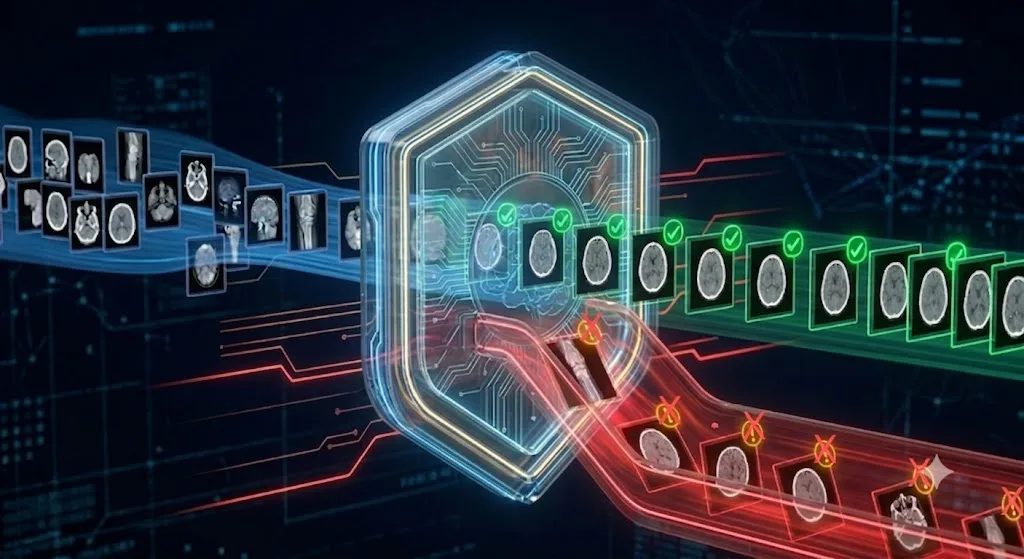
In most clinical trials today, imaging protocol deviations are discovered at exactly the wrong time: after a radiologist has already read the scan.
By then, the damage is done. Reads must be repeated, queries multiply, timelines slip, and regulatory teams inherit a messy inspection narrative. Sponsors and CROs treat this as an unavoidable cost of doing trials at scale.
It isn’t. The gap is structural: most imaging workflows lack a true pre-read protocol QC gate.
This article explains why that gap exists, what a modern pre-read QC layer looks like in practice, and how it changes three things that matter to decision makers: turnaround time, query volume, and inspection risk.
Why Protocol Deviations Are Still Caught After Reads
Legacy imaging workflows were designed around people, not protocol logic:
- Site uploads the scan
- Image management / QC team checks basic quality and PHI
- Case is assigned to a reader
- Radiologist reads and reports
- Central team notices something off (sequence missing, field of view wrong, timing off)
- Query goes back to site; re-scan or re-read is requested
The QC that exists before the read is typically limited to: Is the DICOM intact and viewable? Is PHI removed or masked? Is the scan roughly the right body part and patient?
What it usually does not do is systematically verify:
- Were all required series acquired per the imaging charter?
- Are key parameters (slice thickness, contrast timing, field strength, TR/TE) within allowed ranges?
- Does this scan actually qualify for the timepoint / visit window?
- Are there obvious protocol violations that make the scan unusable for efficacy endpoints?
Those checks are often deferred to the radiologist or a manual coordinator step. As trial protocols become more complex, that approach breaks down. Radiologists are focused on interpretation, not parameter policing. Coordinators are overworked and make inconsistent calls. There is no central, repeatable logic enforcing the imaging charter before reads.
The result is predictable: time is wasted reading scans that later turn out to be non-evaluable, query volume spikes near database lock, and inspection narratives become increasingly difficult to defend.
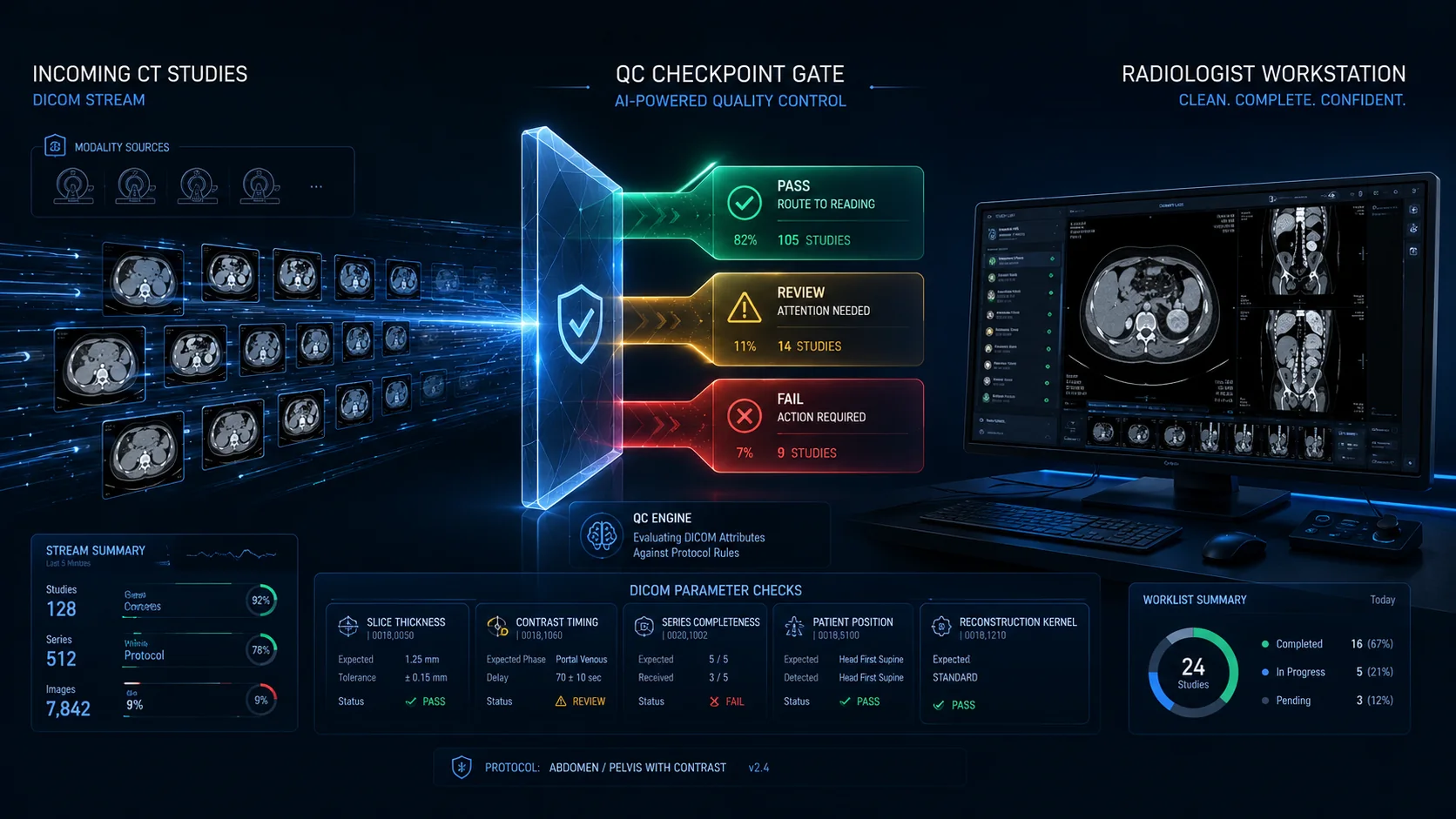
A Simple Example
In a traditional workflow, the scan may be assigned to a reader, interpreted, and reported before the omission is identified. The case then requires a query, potential re-review, and additional coordination.
In a protocol-aware pre-read QC workflow, the missing phase is detected immediately upon upload and routed back to the site before reader assignment — preventing downstream rework entirely.
This is the difference between discovering a protocol deviation before the read versus after it. The deviation itself is the same; the operational consequences are not.
What Pre-Read Protocol QC Looks Like in Practice
A true pre-read QC layer acts like a gatekeeper between upload and assignment. It encodes the imaging charter as executable logic rather than static PDF text. A modern implementation typically includes:
Protocol-Aware Rules Engine
Trial-specific rules derived from the imaging manual: required series, acceptable parameter ranges, contraindications. For example: “For Visit 3, liver CT must include arterial, portal venous, and delayed phases; slice thickness ≤5 mm; IV contrast documented.”
Automated Parameter Extraction
The system parses DICOM headers and series metadata on upload, verifying that expected sequences and parameters are present and within specification — without requiring manual review.
Series Completeness & Consistency Checks
Confirms that all mandatory series for that visit and modality exist. Flags missing or redundant series (e.g., wrong contrast timing, wrong anatomical coverage) before any reader opens the case.
Timepoint & Patient-Level Validation
Confirms the scan belongs to the correct subject, visit, and time window. Detects mislabelled visits or out-of-window acquisitions that would challenge endpoint evaluation.
Clear Disposition Logic
Each incoming case routes into one of three buckets before any radiologist opens it:
Structured Feedback to Sites
Automated notifications that clearly explain the deviation (e.g., “Missing portal venous phase on Visit 2 CT; please review and re-send if available”). Over time, this feedback loop improves site performance across the trial.
From a user’s perspective, this simply means: sites upload as usual, scans that don’t pass protocol QC never reach the reader queue, and readers spend time only on evaluable, protocol-aligned images.
Impact on Turnaround Time
At first glance, adding a QC gate sounds like adding friction. In practice, it does the opposite.
Without pre-read QC: Radiologists read non-compliant scans that later require rework. Queries and repeat reads extend effective TAT per evaluable case. Late-stage clean-up near database lock creates intense pressure just when teams need stability.
With pre-read QC: Reader time is focused on scans that are already evaluable. The volume of “re-do” work drops, freeing capacity and reducing backlogs. Handoffs are cleaner: once a read is complete, it is rarely revisited.
Decision makers should think in terms of effective TAT per protocol-compliant data point, not raw “time from upload to first report.” A pre-read QC layer compresses the true cycle time to stable, analysis-ready reads.
Impact on Query Volume and Data Quality
A significant portion of imaging queries in oncology and other imaging-heavy trials stems from protocol deviations that were not intercepted early. Pre-read QC reduces this by catching structural deviations before reads, standardizing what is acceptable across all sites and coordinators, and generating structured deviation logs that can be reviewed and trended.
Fewer protocol-driven queries means:
- Less operational noise for sites and sponsors
- Fewer back-and-forth cycles that undermine confidence in imaging data
- Cleaner data sets with fewer “rescued” reads of uncertain evaluability
Over time, this also becomes a continuous improvement tool: sponsors can see which sites or modalities consistently deviate and target training accordingly — turning QC data into a strategic site management input.
Impact on Inspection Risk
Regulators care about two things in this context: are you applying your imaging charter consistently, and can you demonstrate control over data that support primary and key secondary endpoints?
Without pre-read QC, the inspection narrative often sounds like: “We relied on radiologists and coordinators to spot deviations. Some non-compliant scans were read; we later excluded or reclassified them. Our documentation of how and when we identified deviations is scattered.”
With a structured pre-read QC layer, the story becomes: “Every scan passed through an automated, protocol-aware QC gate before assignment. All deviations were detected and dispositioned with a documented rationale. Only scans that passed this gate contributed to primary endpoint analyses, and we can show the full audit trail.”
For QA, regulatory, and compliance leaders, this is a fundamentally different risk profile. Instead of relying on detective controls after the fact, the organization can demonstrate preventive controls that operated systematically across the study.
The New Standard for Imaging Operations
As trials become more complex and imaging-rich, the historical approach of “read first, fix later” is no longer tenable. It wastes clinician time, inflates budgets, and introduces inspection risk that is increasingly hard to justify to regulators or internal governance teams.
A protocol-aware pre-read QC layer changes that equation:
- Operationally, it reduces rework and accelerates effective TAT
- Clinically, it protects the integrity and evaluability of imaging endpoints
- Regulatorily, it provides a defensible, audit-ready narrative of control and consistency
The technology and workflows to implement pre-read QC now exist, and early adopters are turning it into a structural advantage: cleaner data, fewer surprises near database lock, and a far stronger story at inspection.
The question for imaging leaders is simple: do you want radiologists spending time discovering protocol deviations one scan at a time? Or do you want a systematic gate that enforces the imaging charter before a human ever opens the case?
Organizations that choose the latter will define the new baseline for imaging quality in trials. Pre-read protocol QC will move from “nice to have” to the expected standard in any imaging-heavy program. The decision is whether you get there early — and benefit from it — or wait until sponsors and regulators start asking why this layer is missing.
Ready to build a pre-read QC layer into your imaging workflows? Talk to the GenPhase team.