ONIX AI™ —The AI-Native Read Platform
ONIX AI™ is the read surface: a browser-based DICOM viewer, voice-to-structured reporting, second-reader review, and Ask ONIX AI — a model purpose-built for radiology — inside a 21 CFR Part 11 audit trail.
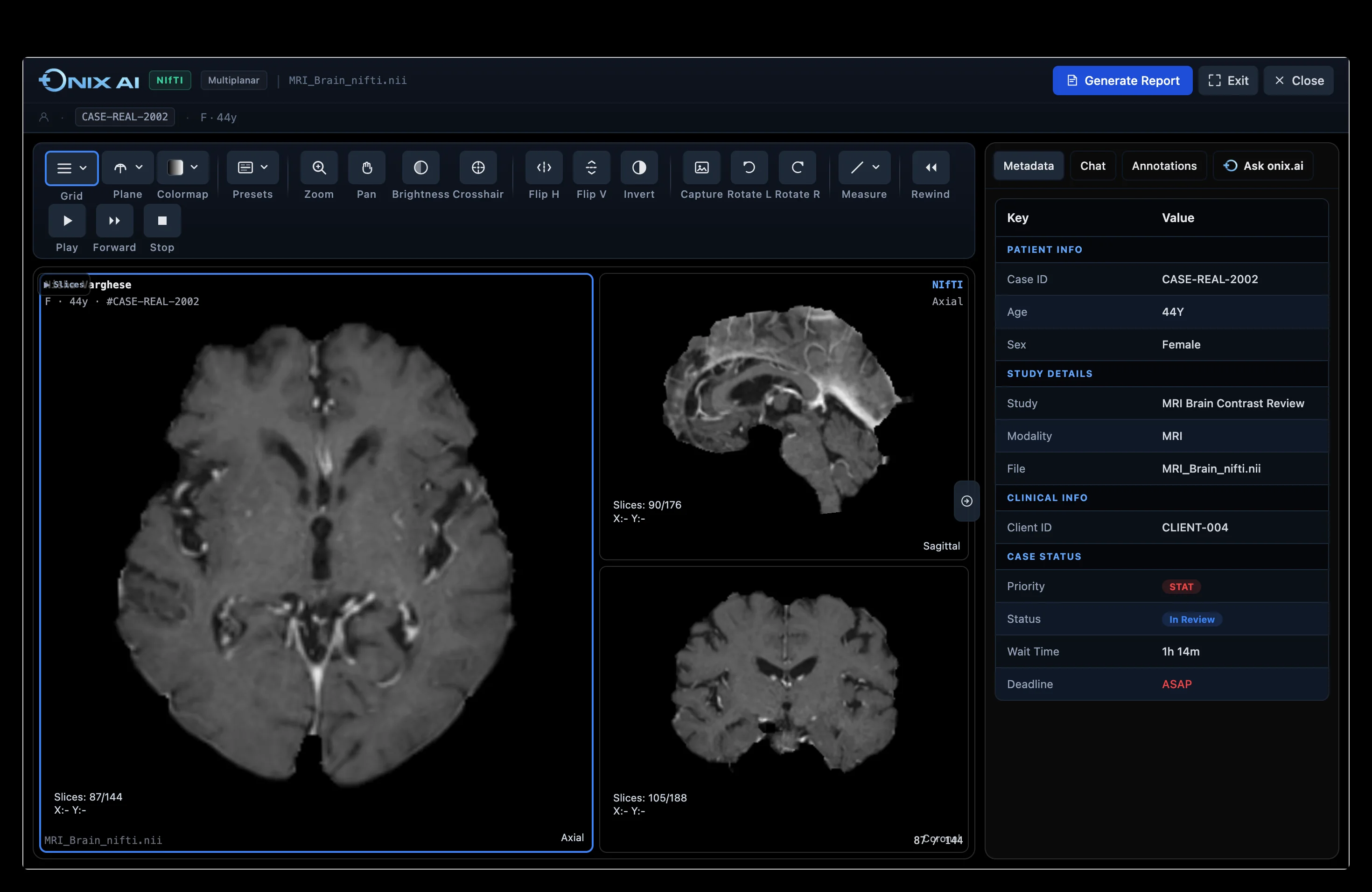
ONIX AI™ is the read surface: a browser-based DICOM viewer, voice-to-structured reporting, second-reader review, and Ask ONIX AI — a model purpose-built for radiology — inside a 21 CFR Part 11 audit trail.
ONIX AI™ is the read surface — not an AI layer bolted onto someone else's viewer. That is why analytics arrive inside the read output rather than as a separate deliverable weeks later.
Browser-based DICOM viewer with multiplanar reconstruction and prior-study overlay. Voice-to-structure reporting. Case Rooms for second-reader review, with finding-level comment threads and a timestamped audit trail.
Ask ONIX AI, a model purpose-built for radiology, drafts findings and answers study-specific questions in the viewer. The same layer is where condition-specific and third-party models plug in.
Subspecialty-aware routing, SLA and QA management, discrepancy and peer review, and credentialed radiologist sign-off inside a 21 CFR Part 11 audit trail. DICOM, HL7 v2.x, FHIR and REST throughout. Cloud or on-premises.
Every scan is validated against the trial's imaging charter before a clinician opens it — catching protocol deviations at the source. ONIX AI checks imaging parameters, series completeness, and compliance requirements automatically, as part of the governance layer running across every read.
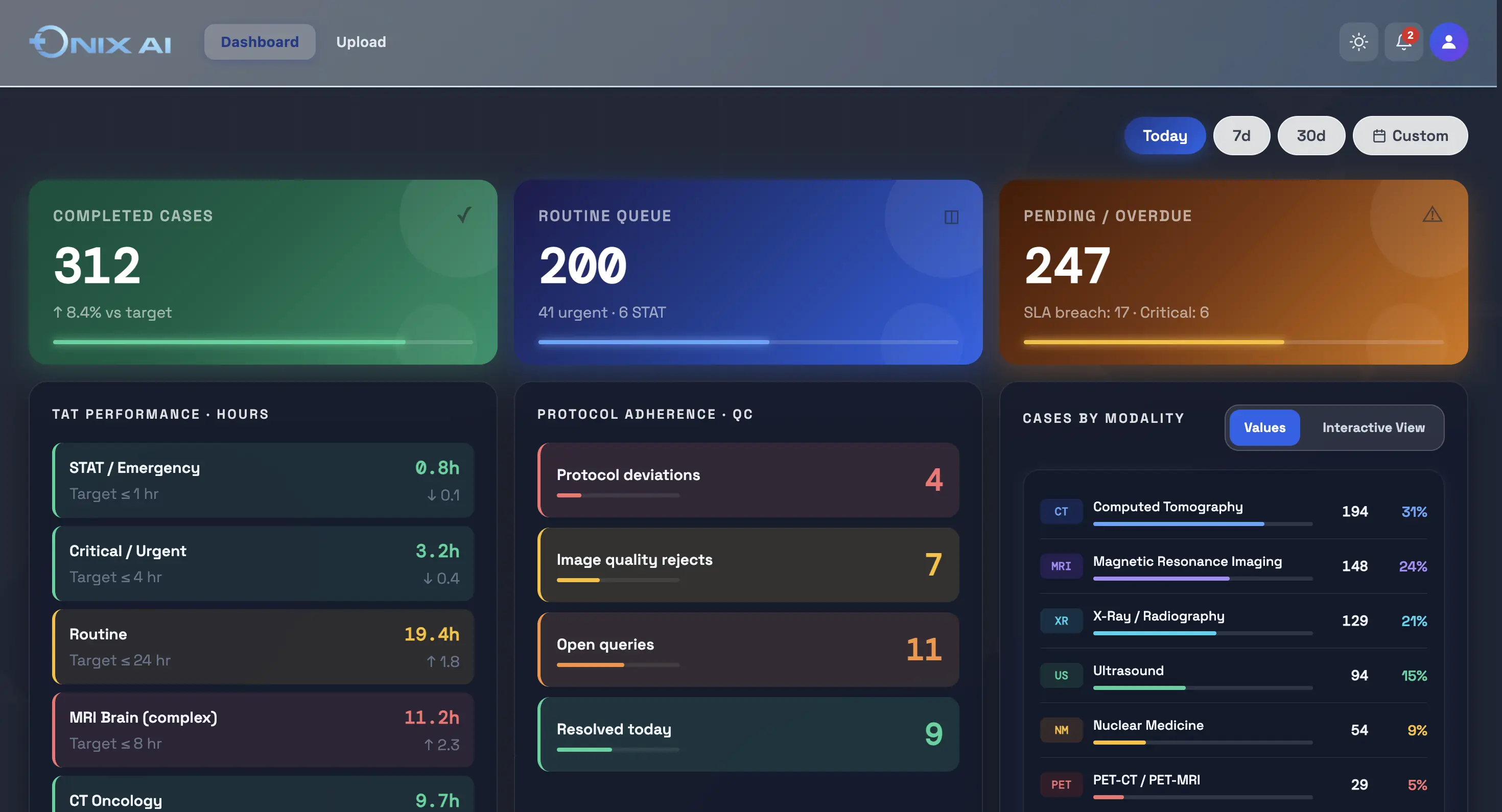
Subspecialty assignment by modality, indication, and reader workload. Blind dual-assignment for BICR with automatic adjudication trigger on concordance failure. Cases flagged urgent under study-defined criteria are escalated to the next available qualified reader.
Ensures the right reader receives the right case at the right time — without manual coordinator bottleneck.
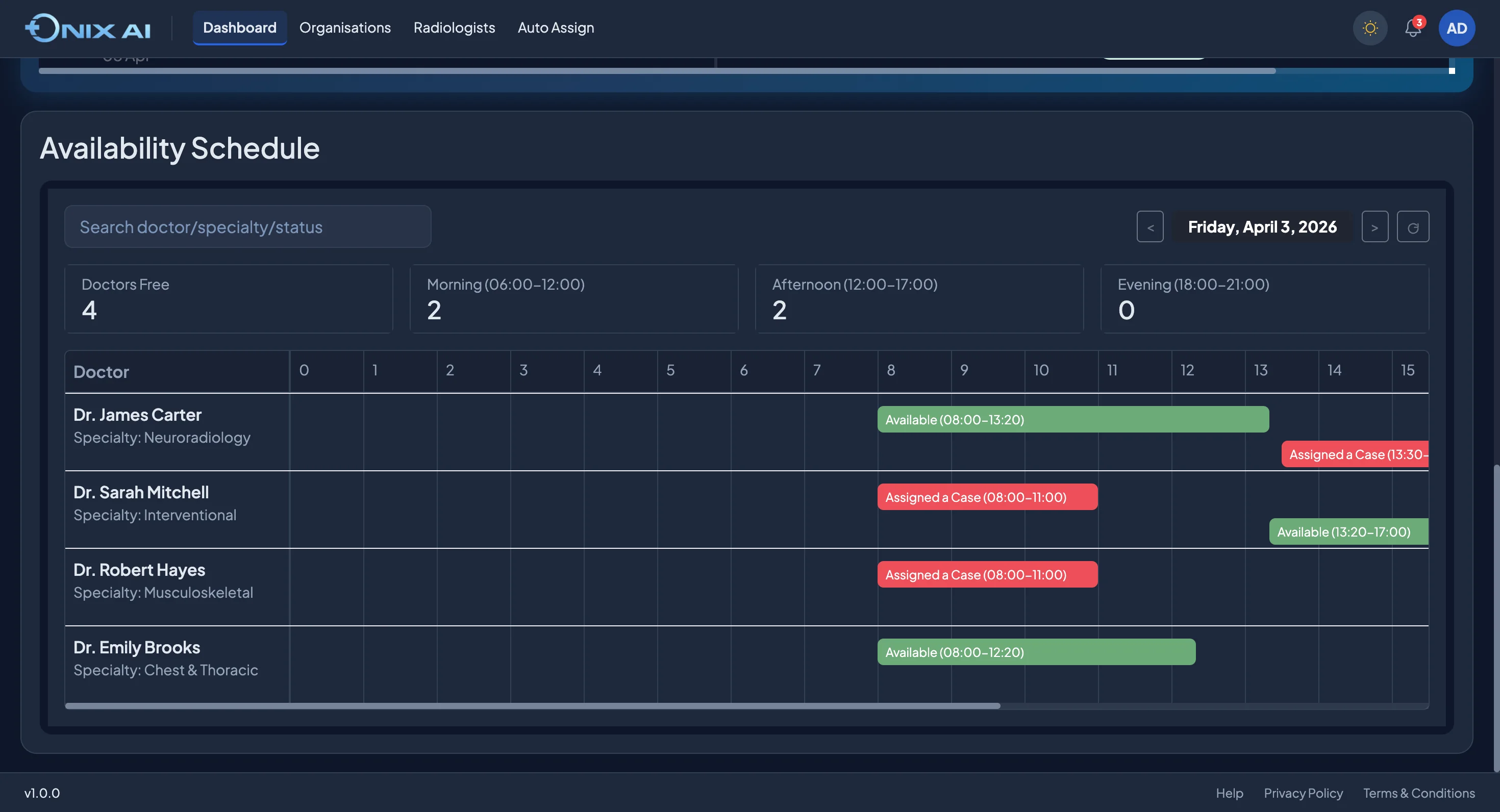
The clinician dictates naturally. ONIX auto-extracts lesion dimensions, classifies and populates target/non-target fields, exports HL7/eCRF-ready structured data.
eCRF-ready structured data delivered into your EDC. No PDF reports for your team to transcribe.

Second-reader review with finding-level comment threads, second-reader invitation, and ownership tracking for the final interpretation — timestamped throughout. Blinded independent central review is supported end-to-end for studies that require it: dual-read assignment, concordance detection, automatic adjudication trigger, third-reader assignment. All events timestamped and cryptographically signed in the audit trail.
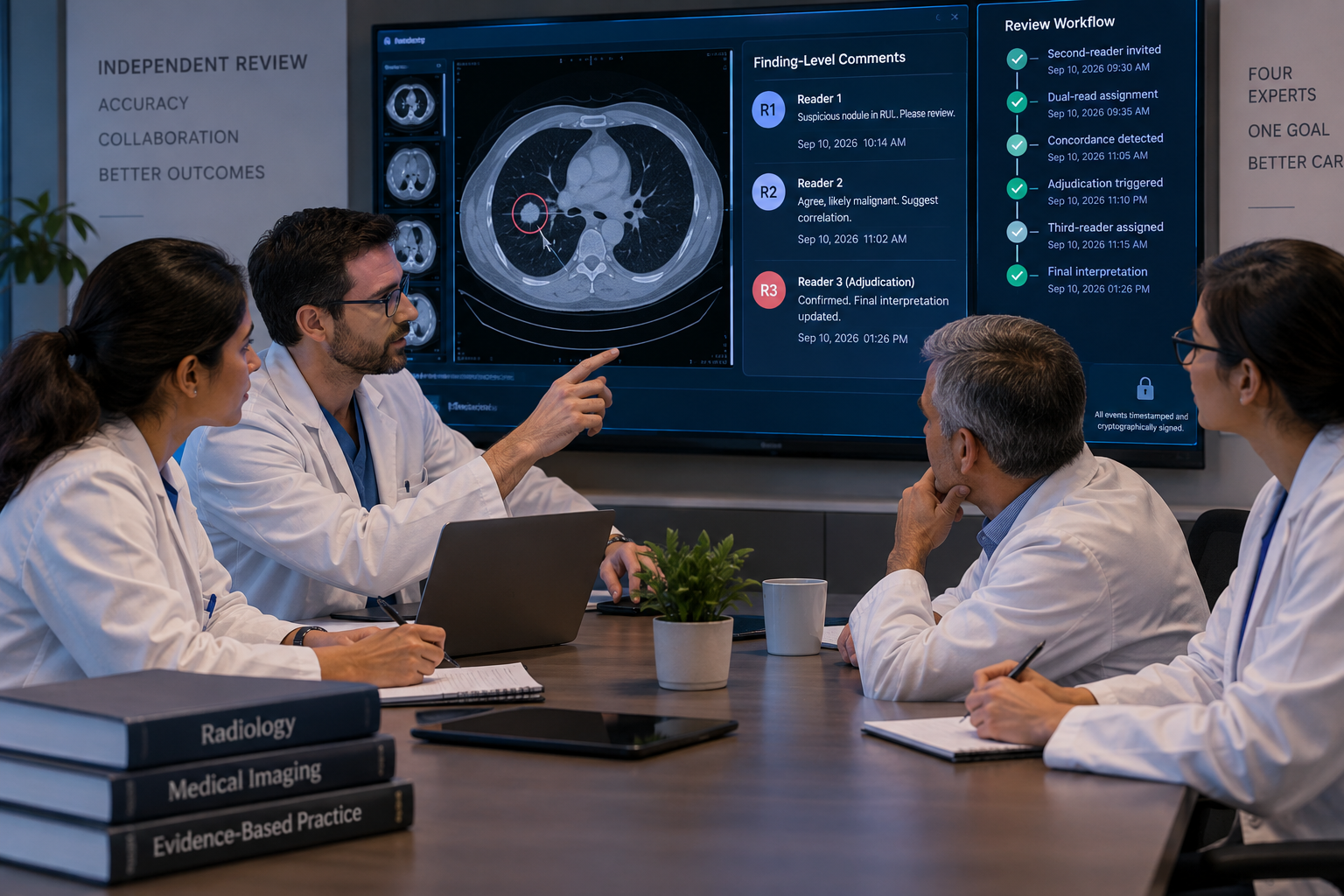
Every read event — upload, QC check, assignment, read, query, sign-off — is cryptographically timestamped in an append-only chain. Designed, operated and maintained in alignment with 21 CFR Part 11, ICH and GAMP 5 requirements. Validation documentation available for sponsor review.
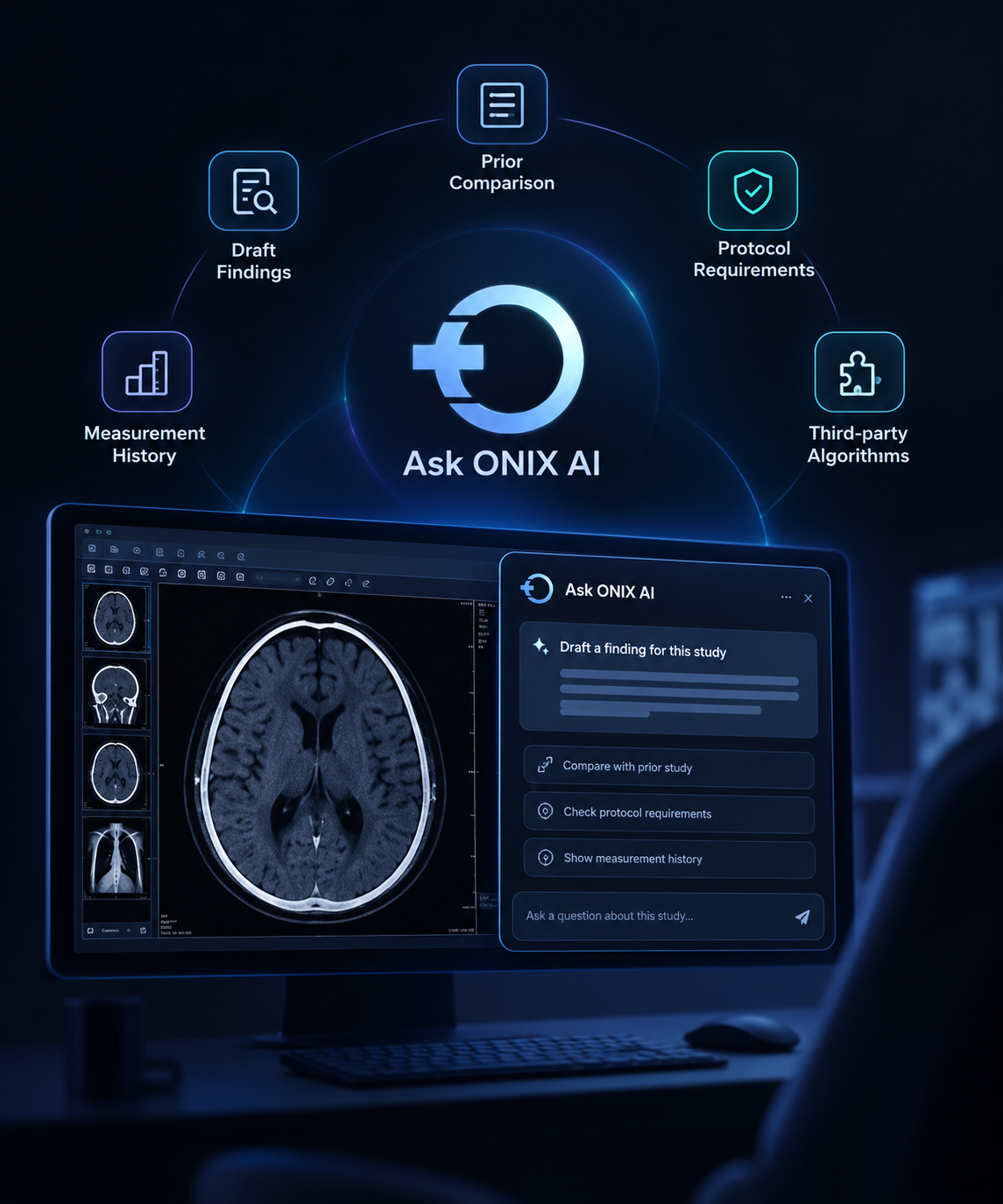
A model purpose-built for radiology, working inside the viewer rather than beside it. It drafts findings from the study in front of the reader and answers study-specific questions in place, without leaving the read.
Bringing a model into ONIX AI is a configuration decision, not an integration project.
ONIX AI™ is built on open standards and integrates with any hospital PACS, any eCRF system, and any third-party algorithm via standard APIs. If you already have imaging infrastructure in place, ONIX is designed to integrate with it.
Third-party algorithms plug into the same intelligence layer as our own models — under the same routing, QA and audit trail.
QC protocols, measurement standards, and report structure are enforced by ONIX AI™ on every read. But credentialed clinicians remain the final signatory on every read event. This is not an automated reporting system — it is an AI-powered platform that makes clinicians faster, more consistent, and audit-ready.
This governance model is designed specifically for GCP and 21 CFR Part 11 environments, where human accountability is a regulatory requirement — not a design choice.
ONIX AI™ provides AI-assisted analysis tools for research use, supporting credentialed radiologist review in clinical trial imaging workflows. The AI assists with lesion detection, measurement pre-population and protocol QA. A board-certified subspecialty radiologist independently validates and signs off on every case.
ONIX AI's intelligence layer is where new capability lands. Response analytics is in development: depth of response as a continuous measure, distance to the 30% partial response threshold with a measurement-confidence band, and lesion-level trajectories — reported alongside the RECIST call, not in place of it. Because ONIX AI is the read environment itself, it arrives inside the read output rather than as a separate analytical deliverable.
The pseudoprogression signature is labeled in the annotation schema for our solid tumor CT model from the start, so that flagging it becomes a capability of the read rather than something a site has to catch. Condition-specific models follow, starting with thoracic-anchored solid tumor CT, landing in the same intelligence layer under the same routing, QA and audit trail.
Every output runs research-use, inside the same routing, QA and audit trail, with a credentialed radiologist signing every case.
Request a 30-minute platform walkthrough with our clinical and technical team.
Not ready for a walkthrough? See how a first engagement works →
1990 N California Blvd., 8th Floor
Walnut Creek, CA 94596
(844) 922-7468
hello@genphase.ai
Fill out the form and our clinical and technical team will reach out within 24 hours.
By submitting this form, you agree to let GenPhase use the information provided to send relevant content about our services. You can unsubscribe at any time.