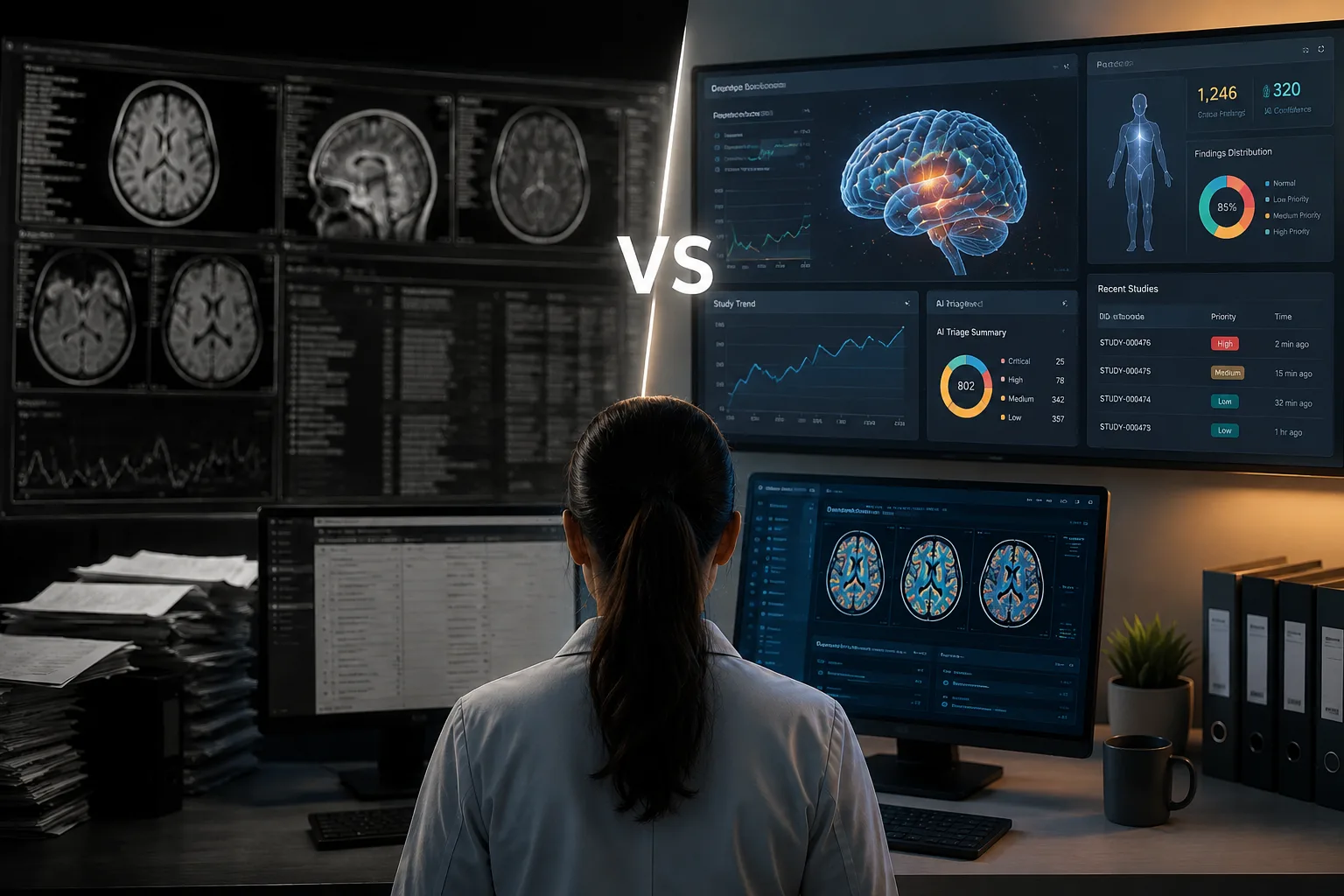
In Part I, we explored the conceptual foundation of AI in clinical imaging — the distinction between automation and intelligence, the evolution through three phases, and the architectural differences between AI-native and legacy platforms. Now we turn to the practical question that matters most to trial sponsors and CROs: where does AI deliver measurable impact, and how do you implement it without introducing execution risk?
The answer lies in understanding which operational bottlenecks create the most delay, cost, and compliance risk, and how intelligent orchestration addresses them. This isn’t about adopting technology for its own sake. It’s about solving specific, high-stakes problems that legacy manual processes cannot handle at the scale and velocity modern trials require.
Strategic Use Cases Where AI Delivers Measurable Impact
While AI’s potential in clinical imaging is broad, certain use cases deliver disproportionate strategic value. These are the areas where intelligent automation directly addresses high-cost pain points or unlocks capabilities that were previously infeasible.
Accelerating Study Start-Up
Traditional site activation for imaging trials takes 4–8 weeks: protocol training, imaging manual distribution, qualification scans, connectivity testing. Much of this is manual coordination across sites, vendors, and internal teams. Every email thread, every follow-up call, every manual check adds days to the timeline.
AI-native platforms compress this timeline to 72 hours by automating the entire activation sequence:
- Automated protocol configuration: The protocol document is parsed into machine-readable acceptance criteria, eliminating manual setup
- Site-specific imaging manual generation: The system automatically generates customized manuals based on site equipment and capabilities
- Interactive training modules: AI-driven comprehension checks ensure site staff understand protocol requirements before activation
- Remote connectivity validation: Automated test uploads verify PACS connectivity and image transfer protocols without manual coordination
For sponsors managing portfolios of trials, this acceleration compounds. A platform that activates sites in days rather than weeks can launch more trials in parallel, respond faster to competitive threats, and reduce the fixed costs of trial management infrastructure. It is this end-to-end automation that makes fast site activation possible.
Enabling Real-Time Protocol Compliance Monitoring
Protocol deviations in imaging are expensive. A missed sequence, incorrect contrast timing, or wrong imaging plane can render a timepoint unusable — requiring a repeat scan, delaying dosing decisions, or creating missing data that complicates regulatory submissions.
Traditional QC catches these deviations after the read, when remediation is difficult or impossible. A radiologist spends time reviewing a non-compliant scan, discovers the problem, and initiates a query cycle that delays the trial and frustrates sites.
AI-powered pre-read QC inverts this model. Before any scan reaches a radiologist, the system evaluates it against protocol-defined acceptance criteria:
- Correct imaging modality (CT vs. MRI)
- Required sequences present (T1-weighted, T2-weighted, contrast-enhanced)
- Proper anatomical coverage (entire tumor visible, correct slice thickness)
- Acceptable image quality (no motion artifacts, appropriate contrast)
Cases that fail these checks are flagged immediately and routed back to the site for correction or clarification. Only protocol-compliant cases proceed to the read queue. This reduces post-read queries by 30–40% and ensures radiologists spend their time on interpretable, protocol-compliant imaging.
But the strategic value goes beyond individual case QC. Aggregated deviation data enables real-time site performance monitoring:
- Which sites have high deviation rates?
- Which specific protocol requirements are most frequently missed?
- Which imaging facilities consistently deliver compliant scans?
This intelligence allows proactive intervention — targeted retraining, site audits, or imaging vendor changes — before problems compound into data quality crises that jeopardize endpoints.
Optimizing Global Reader Networks
Managing a distributed network of subspecialty radiologists across time zones, languages, and workload capacities is operationally complex. Manual assignment by project managers introduces delays, creates bottlenecks when preferred readers are unavailable, and lacks the real-time adaptability needed to maintain SLA compliance.
AI-driven assignment systems treat this as a continuous optimization problem: match incoming cases to available readers based on:
- Subspecialty expertise: Neuro-radiologists for brain imaging, musculoskeletal specialists for orthopaedic trials
- Language requirements: Matching reader language capabilities with site locations
- Current workload: Balancing case volume across readers to prevent bottlenecks
- Historical turnaround performance: Prioritizing readers with consistent fast turnaround
- Time zone optimization: Routing cases to readers in active work hours for faster completion
The system learns from outcomes over time:
- Which readers excel at specific modalities?
- Which reader pairs have low adjudication rates (indicating consistent interpretation)?
- Which assignment patterns correlate with faster turnaround?
Over time, the network becomes more efficient without adding headcount. This is how ONIX AI™ delivers 24/7 global read coverage — not by hiring more radiologists, but by optimizing how existing capacity is utilized.
Supporting Adaptive Trial Designs
Adaptive trials require rapid endpoint assessment to inform dose escalation, cohort expansion, or futility decisions. Traditional imaging workflows — with manual routing, batch processing, and days-long turnaround — are incompatible with the operational tempo adaptive designs require.
AI-native platforms enable “fast-track” pathways for decision-critical time points:
- Priority routing: Cases flagged as decision-critical bypass the standard queue
- Real-time reader availability matching: The system identifies and assigns available readers immediately
- Automated adjudication triggering: Discrepancies are detected and routed to adjudicators without manual coordination
- Immediate structured data export: Results flow directly to decision-making systems via API
This capability transforms imaging from a lagging indicator (results available weeks after the scan) to a near-real-time input to trial decision logic — unlocking trial designs that were previously operationally infeasible.
The Economics of AI-Native vs. Legacy Imaging Operations
The business case for AI in clinical imaging is ultimately economic: does the technology reduce costs, compress timelines, or improve quality enough to justify the investment?
The answer depends on the scale and complexity of the imaging program. For small, simple trials with low case volumes, the operational overhead of legacy manual processes may be acceptable. But for large, multi-site, multi-modality trials with complex endpoints, the economics favor AI-native platforms decisively.
Cost Analysis: Phase III Oncology Trial Example
Consider a Phase III oncology trial with 300 sites, 1,000 patients, and serial imaging every 8 weeks over 18 months. Total imaging volume exceeds 6,000 time points. Managing this manually requires:
- Project managers to coordinate site activation and ongoing communication
- QC reviewers to check every scan post-read for protocol compliance
- Data coordinators to transcribe PDF reports into eCRF systems
- Operations leads to manually assign cases and manage reader workload
- Clinical teams to manage adjudication when readers disagree
An AI-native platform automates 60–70% of these tasks, reducing the operational team size by 40–50% while delivering faster turnaround and higher consistency. At scale, this translates to:
Both cost savings and timeline compression directly impact trial ROI and competitive positioning. In therapeutic areas where being first to market determines market share, weeks of timeline advantage can translate to hundreds of millions in revenue.
Scalability Economics
Equally important, AI-native platforms scale sub-linearly. Doubling case volume does not double operational costs because the intelligent orchestration layer handles increased complexity without proportional increases in human oversight.
Legacy models scale linearly: more cases require more project managers, more QC reviewers, more data coordinators. AI-native models scale logarithmically: the same platform and operational team can handle 2x, 5x, or 10x case volume with only incremental increases in infrastructure costs.
This economic advantage compounds over time. Organizations running multiple trials simultaneously can leverage a single AI-native platform across their entire portfolio, amortizing the technology investment across hundreds of studies.
Implementation Roadmap: How to Transition to AI-Native Imaging
For organizations currently using legacy imaging CROs, transitioning to an AI-native model requires careful planning. The goal is to capture operational benefits without introducing execution risk mid-trial.
Step 1: Assess Current State and Pain Points (Weeks 1–2)
Conduct a structured assessment of current imaging operations:
- Average site activation timeline
- Read turnaround times by modality and complexity
- Query volumes and resolution times
- Protocol deviation rates by site
- Operational team size and cost per read
Identify the highest-impact pain points — the areas where manual processes create the most delay, cost, or risk. These become the primary success metrics for the pilot.
Step 2: Pilot with a Non-Critical Trial (Months 1–3)
Select a Phase I or Phase II trial with moderate imaging complexity to pilot an AI-native platform. Avoid starting with a registration-enabling Phase III trial where execution risk is highest. The pilot objectives are:
- Validate that the platform can handle your specific protocol requirements
- Confirm performance improvements (site activation speed, read turnaround, query reduction)
- Train your team on the new system
- Build confidence before transitioning critical programs
Step 3: Validate Operational Metrics (Month 3)
Compare pilot performance against baseline metrics:
- Did site activation compress from weeks to days?
- Did read turnaround improve by the claimed 30–40%?
- Did query volumes decrease due to pre-read QC?
- Did structured data integration reduce eCRF transcription time?
Use this data to build the business case for broader adoption. Quantify the cost savings, timeline compression, and quality improvements in terms that resonate with executive stakeholders.
Step 4: Expand to Portfolio (Months 4–12)
Roll out the AI-native platform across the trial portfolio, starting with new studies and transitioning existing studies at natural inflection points: new cohort activations, protocol amendments requiring workflow changes, or site expansions into new geographic regions. Avoid forcing mid-trial transitions unless there’s a compelling operational reason. The goal is smooth adoption, not disruption.
Step 5: Optimize and Scale (Ongoing)
Continuously refine protocol templates, quality thresholds, and reader network configuration based on performance data. As the platform learns from more trials, operational efficiency compounds. Establish feedback loops between clinical operations teams and the technology platform to identify new automation opportunities and refine existing workflows.
The Competitive Landscape: Who’s Leading and Who’s Lagging
The clinical imaging CRO market is bifurcating. A small number of technology-forward providers are investing heavily in AI-native platforms, while the majority of legacy iCROs are adding AI features incrementally without rethinking their core architecture.
This creates a widening operational gap. AI-native providers can activate sites in days, deliver reads in hours, and scale across hundreds of concurrent trials with lean operational teams. Legacy providers remain constrained by manual processes, high fixed costs, and limited scalability.
Due Diligence Questions for Imaging Partners
- Is AI embedded in the workflow engine or bolted onto legacy systems? Ask to see the architecture diagram and understand where AI sits in the technology stack.
- Can the platform activate a site in 72 hours, or does it require weeks? Request case studies with documented activation timelines.
- Are reports structured and API-integrated, or PDFs requiring manual transcription? Ask for demonstrations of eCRF integration and structured data export.
- Is the audit trail unified and immutable, or fragmented across systems? Request audit trail documentation showing full traceability from image upload to final data export.
- Can the vendor provide validation documentation for AI models? Ask for model validation reports, performance metrics, and change control procedures.
The answers reveal whether a provider is genuinely AI-native or simply rebranding legacy operations with AI marketing.
Conclusion: Intelligence as Infrastructure
AI in clinical imaging is no longer an experimental technology — it is rapidly becoming table stakes for competitive trial execution. The organizations that recognize this shift early and build their imaging operations around intelligent orchestration will capture significant advantages in speed, cost, and quality.
But this transition requires more than adopting new tools. It requires rethinking how imaging operations are structured, how teams are organized, and how technology and clinical expertise combine to deliver regulatory-grade execution at scale.
The future of clinical imaging is not radiologists replaced by algorithms. It is credentialed clinicians empowered by intelligent systems that handle operational complexity, enabling them to focus on medical judgment, protocol adherence, and patient safety.
For sponsors and CROs ready to make this transition, the path is clear: evaluate your current imaging operations, identify the highest-impact pain points, pilot an AI-native platform, and scale based on validated performance improvements.
Ready to implement AI-native imaging execution?
Explore ONIX AI™ or talk to our clinical team about your imaging challenges and implementation roadmap.
Explore ONIX AI™ Contact Our Clinical TeamFrequently Asked Questions
What are the most impactful use cases for AI in clinical imaging?
The highest-impact use cases are accelerating study start-up, enabling real-time protocol compliance monitoring through pre-read QC, optimizing global reader networks for faster turnaround, and supporting adaptive trial designs with near-real-time endpoint assessment.
How much does AI-native imaging reduce operational costs?
For large Phase III trials with 6,000+ imaging timepoints, AI-native platforms can reduce operational team size by 40–50% and deliver $2–3 million in cost savings over the trial lifecycle through automation of case routing, QC, data transcription, and adjudication management.
How long does it take to implement an AI-native imaging platform?
A phased implementation typically takes 3–12 months: 1–2 weeks for assessment, 1–3 months for a pilot with a non-critical trial, 1 month for metrics validation, and 4–12 months for portfolio-wide rollout. Individual study activation on an established platform can occur in 72 hours.
What should I pilot first when transitioning to AI-native imaging?
Start with a Phase I or Phase II trial with moderate imaging complexity — enough to test the platform’s capabilities but not so critical that execution risk threatens regulatory timelines. Avoid starting with registration-enabling Phase III trials until the platform is validated.
How do I measure success during an AI imaging pilot?
Compare baseline metrics to pilot performance: site activation timeline (weeks to days), read turnaround time (30–40% improvement target), query volumes (reduction due to pre-read QC), and eCRF transcription time (elimination through structured data integration).
Can AI-native platforms handle complex, multi-modality trials?
Yes. AI-native platforms are specifically designed for protocol complexity. The “protocol as configuration” approach means acceptance criteria, read requirements, and adjudication rules are defined per protocol without custom coding, making complex multi-modality trials easier to manage than on legacy systems.
What’s the difference between AI-native and legacy imaging CROs adding AI features?
AI-native platforms are built from the ground up with AI driving workflow orchestration, case routing, and quality decisions. Legacy CROs add AI features (image quality checkers, measurement tools) to existing manual workflows without changing the underlying architecture, delivering incremental rather than transformational improvements.
How does AI in clinical imaging support adaptive trial designs?
AI enables fast-track pathways for decision-critical time points through priority routing, real-time reader availability matching, automated adjudication triggering, and immediate structured data export via API — transforming imaging from a weeks-long lagging indicator to a near-real-time decision input.
What due diligence should I conduct when evaluating AI imaging partners?
Ask architectural questions: Is AI embedded in the workflow engine? Can sites be activated in 72 hours? Are reports structured and API-integrated? Is the audit trail unified? Request demonstrations of pre-read QC, intelligent routing, and structured data integration, plus validation documentation for AI models.
How do AI-native platforms scale compared to legacy operations?
AI-native platforms scale sub-linearly — doubling case volume doesn’t double operational costs because intelligent orchestration handles complexity without proportional increases in human oversight. Legacy operations scale linearly, requiring more staff for more cases, making AI-native platforms increasingly cost-advantageous at scale.
New here? Start with Part I
Read the conceptual foundation — the shift from automation to intelligence, the three phases of AI evolution, and the architectural differences between AI-native and legacy platforms.
Read Part I