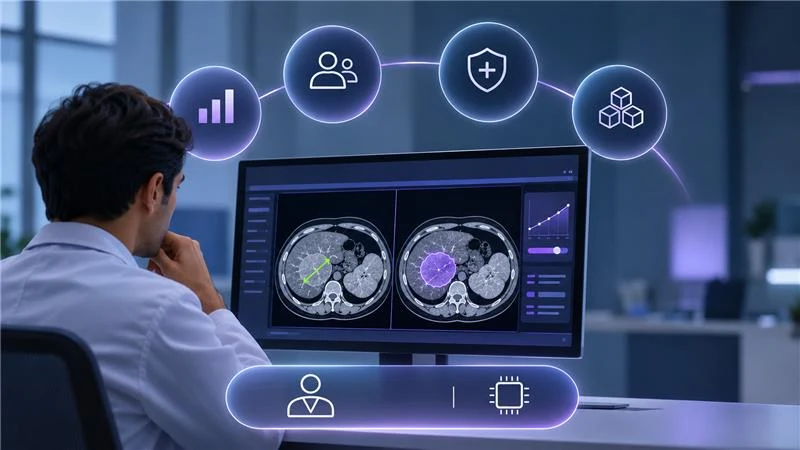
A multi-stakeholder working group convened by Friends of Cancer Research this year set out how AI-enabled tumor assessment could support clinical trial endpoints. Its most useful contribution for a small sponsor is not what it settles. It is the list of questions it deliberately leaves open.
Why the open questions matter more than the answers
A white paper that declared the matter closed would be easy to cite and easy to over-read. This one does something more useful for a sponsor planning a study: it marks where the field has not yet agreed. Those are the places where a protocol decision made today can be questioned later, by a partner, an investor or a reviewer.
Four of the open questions bear directly on how an early-phase sponsor reads its own imaging data. They are taken here from the working group’s paper, and the framing is the working group’s, not ours.
Open question 1: Do continuous scores need strict cut points?
RECIST works because it sorts patients into categories at fixed thresholds: a 30% decrease for partial response, a 20% increase for progression. A continuous measure of response has no such line built in. The paper asks whether it needs one and, if it does, how the line should be set.
For a sponsor reporting a continuous measure today, the practical reading is plain. Report it beside the RECIST call, not in place of it, and say openly that it is exploratory. A measure without an agreed threshold can support an argument. It cannot yet carry a decision rule.
Open question 2: Who counts as a progressor?
The paper also asks how progressors should be defined, and whether a definition is needed at all if the endpoint becomes continuous.
Whatever the endpoint becomes, progression remains the call that ends treatment for the patient in front of the investigator. That is why confirming progression before treatment stops does not become less important as endpoints change. A continuous analysis can reshape how a trial is summarized. It does not change who comes off therapy on a given Tuesday.
Open question 3: How should pseudoprogression be handled?
The paper lists the difficulty of separating treatment-related change from true tumor growth as a limitation of RECIST, and it notes that iRECIST has not been used as a formal endpoint in registrational trials. It asks how to avoid excluding patients who show pseudoprogression.
The problem it describes is a familiar one. Under immunotherapy, tumors can enlarge and new lesions can appear before disease shrinks or resolves. Patients are told they progressed and come off therapy, and sites are not consistently trained to recognize the pattern.
A question the field has not answered is a reason to write the charter carefully, not a reason to wait. How a study handles an unconfirmed progression should be decided before the first patient is scanned.
Open question 4: Should volume replace diameter?
The paper notes that volumetric assessment of all lesions may better capture the most aggressive lesions than a handful of diameters, and that measuring volume still lacks standardization. Both statements are true at once, and neither is settled.
For a sponsor, the sensible position is the field’s own: volume is promising, it is not yet standardized, and a study that depends on it should say how it was measured and by whom.
Open question 5: Where does the paper land on readers?
On one point the paper is unambiguous. It keeps a human with final decision-making authority, with AI as a reference. We agree, plainly: AI assists, radiologists decide.
For a sponsor, that has a concrete meaning. Every measurement that reaches your database should have a named, qualified reader behind it and an audit trail showing what that reader did.
GenPhase.ai is an imaging core lab for oncology sponsors, built on ONIX AI™, the environment in which the read happens: image review, signed reads and a 21 CFR Part 11 audit trail in one place, with a credentialed radiologist confirming every case.
- Friends of Cancer Research. Leveraging AI-Enabled Tumor Assessment Tools on Radiological Images to Evaluate Treatment Effect and Support Clinical Trial Endpoints in Solid Tumors. White paper. 2026.