From tumor measurement
to response insight.
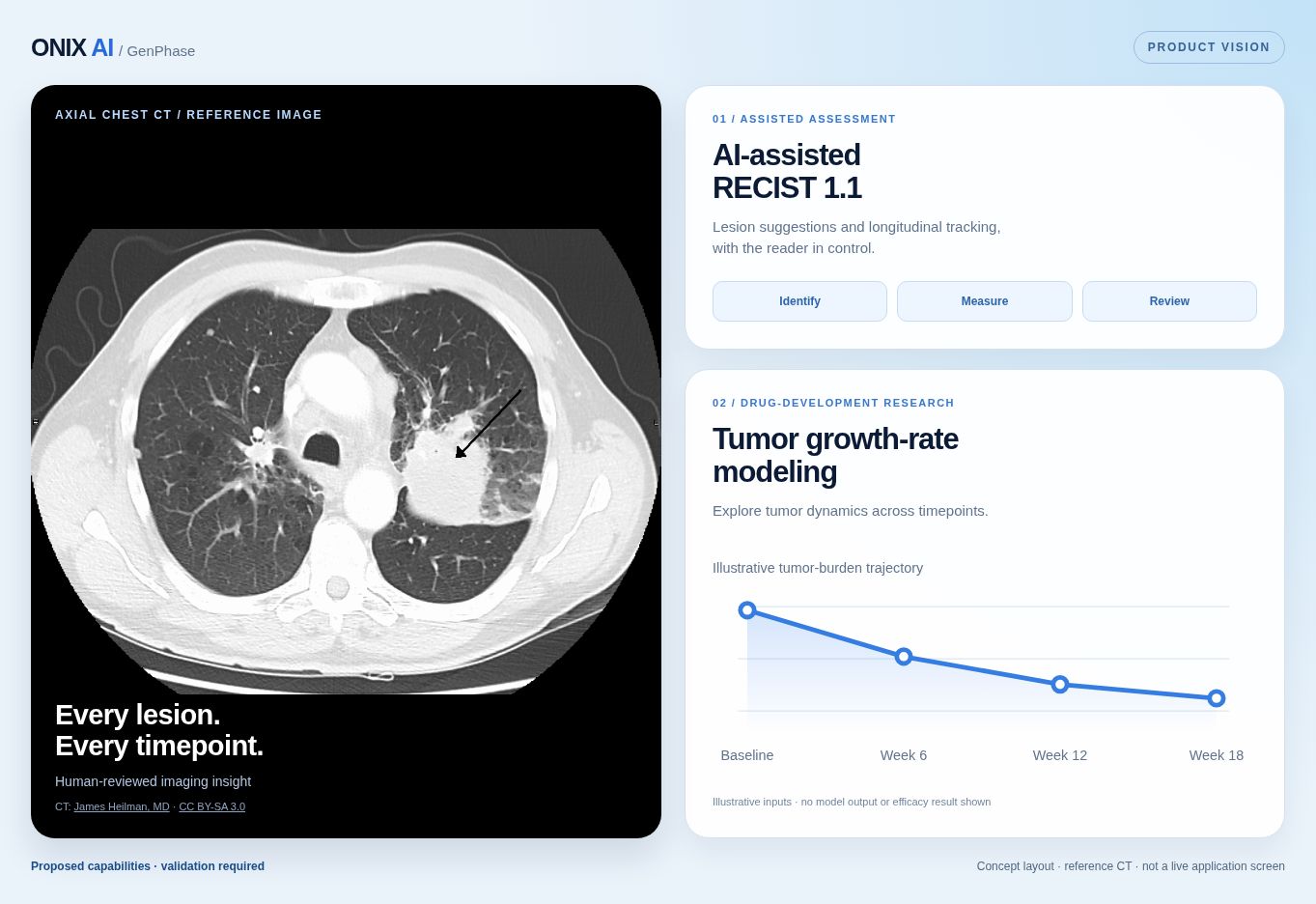
Connect oncology image review, structured assessments and trial operations. Our product vision extends this workflow with AI-assisted RECIST 1.1 and tumor growth-rate modeling to support drug-efficacy research.
Every image belongs to a study.
Every read needs context.
Oncology imaging depends on more than access to scans. Teams need the subject and timepoint, the applicable assessment criteria, the review owner and a clear view of what happens next. ONIX brings these elements into purpose-specific workspaces.
RECIST documentation, beside the images.
Observed in portalReview DICOM images and document target, non-target and new-lesion findings within the same workspace. The RECIST 1.1 / iRECIST template brings baseline measurements, response categories and reader rationale into a consistent report structure.
- Target-lesion records with organ, method and measurement fields.
- Non-target disease and new-lesion documentation.
- Overall response and reader comments in a structured template.
Keep measurement tools within reach.
Observed controlsMove from image review to measurement without leaving the browser. The viewer exposes length, bidirectional, rectangle, circle and freehand tools, with series navigation, window/level and multiplanar controls.
- Length and bidirectional measurement controls.
- Region-of-interest tools and an annotation panel.
- Report, template and version-history controls alongside image review.
Give every imaging visit its place.
Sample analyticsOrganize imaging around the subject and visit, with baseline and follow-up worklist filters and scheduled upload timepoints. Sponsor endpoint views demonstrate how response summaries can be presented alongside study operations.
- Subject and visit selection at image submission.
- Baseline and follow-up worklist filters.
- Endpoint waterfall and response summaries displayed with sample data.
RANO 2.0 starts with the study protocol.
Configuration visibleRANO 2.0 appears in the study-configuration interface alongside a recurrent-glioblastoma study marked Start-up. This is the current evidence for ONIX’s neuro-oncology pathway. A complete RANO-specific measurement, clinical-context and response workflow remains to be demonstrated.
- RANO 2.0 is visible as a response-criteria option.
- Neuro-oncology study card specifies pre- and post-contrast brain MRI.
- Dedicated RANO assessment and longitudinal MRI demonstration: proposed next showcase.
From site images to trial-ready submissions.
Upload observed · routing proposedSite teams can submit DICOM files or study folders, link images to a coded subject and visit, and follow submission status. PACS/DICOM routing is a proposed integration option for connected sites; trial-specific matching, de-identification and completeness checks remain part of intake.
- Browser upload with subject, visit and acquisition context.
- Visit schedules, submission status and query follow-up.
- Proposed PACS/gateway routing, qualified for each site and study.
See the handoffs that move a study forward.
Observed in portalFollow the imaging pipeline from site confirmation and QC intake through reader assignment, independent reads, adjudication and lock. Core-lab screens bring workload, recent activity and study settings into one operational view.
- QC intake queues and release history.
- Reader assignment and workload visibility.
- Study criteria, read paradigm and adjudication-trigger configuration.
Know where the imaging work stands.
Live UI + sample panelThe sponsor workspace brings received timepoints, QC summaries, study stages and site activity together. Separate endpoint and transfer views provide a place to review response presentations and delivery status.
- Operational stage and timepoint summaries.
- Site-level activity and reader-concordance displays.
- Endpoint view and transfer register; production export validation remains a separate step.
Designed around the people
doing the work.
Site coordinator
Prepare submissions, monitor visit schedules and follow queries.
Reader
Open assigned studies, inspect images and document the assessment.
Core lab
Review intake, coordinate readers and oversee study configuration.
Sponsor
Follow site activity, imaging stages and endpoint presentations.
Make the next capability visible—and verifiable.
Proposed next demonstrations include a complete RANO-specific assessment, lesion-linked baseline-to-follow-up comparisons, and verified structured data exports. GenPhase’s existing roadmap also identifies response analytics and pseudoprogression research as in development.
See your oncology workflow
in ONIX AI.
Walk through study setup, site intake, image review and sponsor oversight with the GenPhase team.